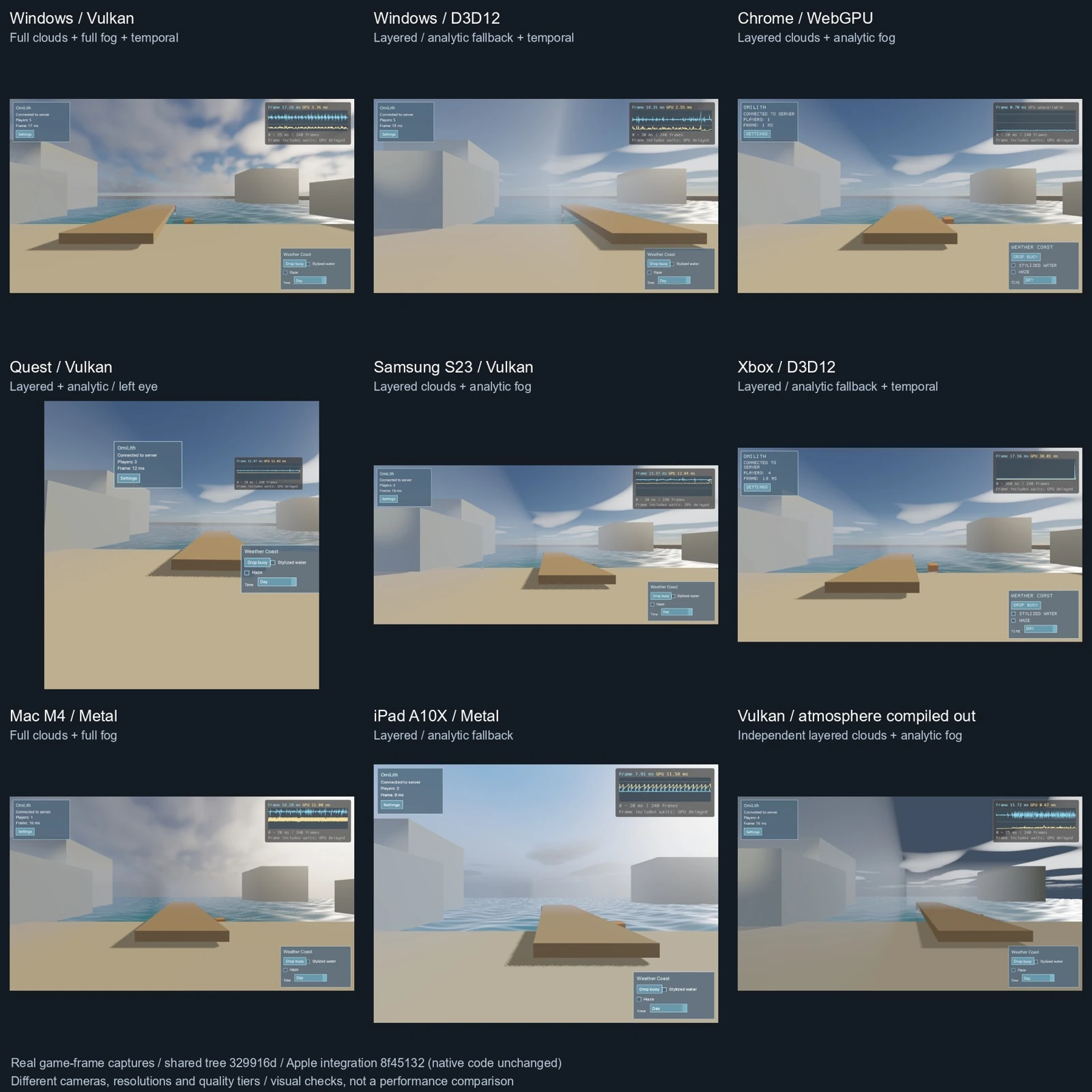
The lighting and visibility review moved into its accepted checkpoint, while the environment work connected sky, sunlight, fog, and water to a common description of the world. The temporal path added another kind of shared agreement: old image information is useful only while its view and scene identity remain valid.
Fix the handoff, not only the final picture
The diary records corrections to the Metal jitter handoff and finite fog behavior. Device checks then made the selected tiers visible, including paths that had previously lacked the required evidence. This was not a claim that every image should be pixel-identical. It was a way to inspect whether each selected route was executing the intended feature and respecting its inputs.
The temporal-history note follows the ownership and reset decisions. The shared-environment article explains why atmosphere data should be useful to more than the sky pass. Both distinguish the accepted foundation from later quality work.
Give games their own roots
The independent-project milestone made consumer-owned application lifecycles, components, cooking, and inspection explicit. Examples and server-control tooling moved into their own projects. Work on reusable game foundations followed, so a new consumer would not have to reconstruct platform behavior from unrelated game code.
The same window contains early Asset Atelier experiments with generated geometry, segmentation, rigging, and animation. A locally completed pipeline was useful evidence, but it also exposed retopology limitations. Those experiments belong to the creative-tool branch of the journey, not to a claim that every generated asset was ready for runtime use.
By the end of the period, a Linux authority had passed a real two-client Windows connection check, and device comparison material had been posted. The larger lesson was becoming consistent: keep reusable contracts in the engine, application choices in the consumer, and evidence attached to the particular route that produced it.
Have a thought or a question?
I'd love to hear it. ↗