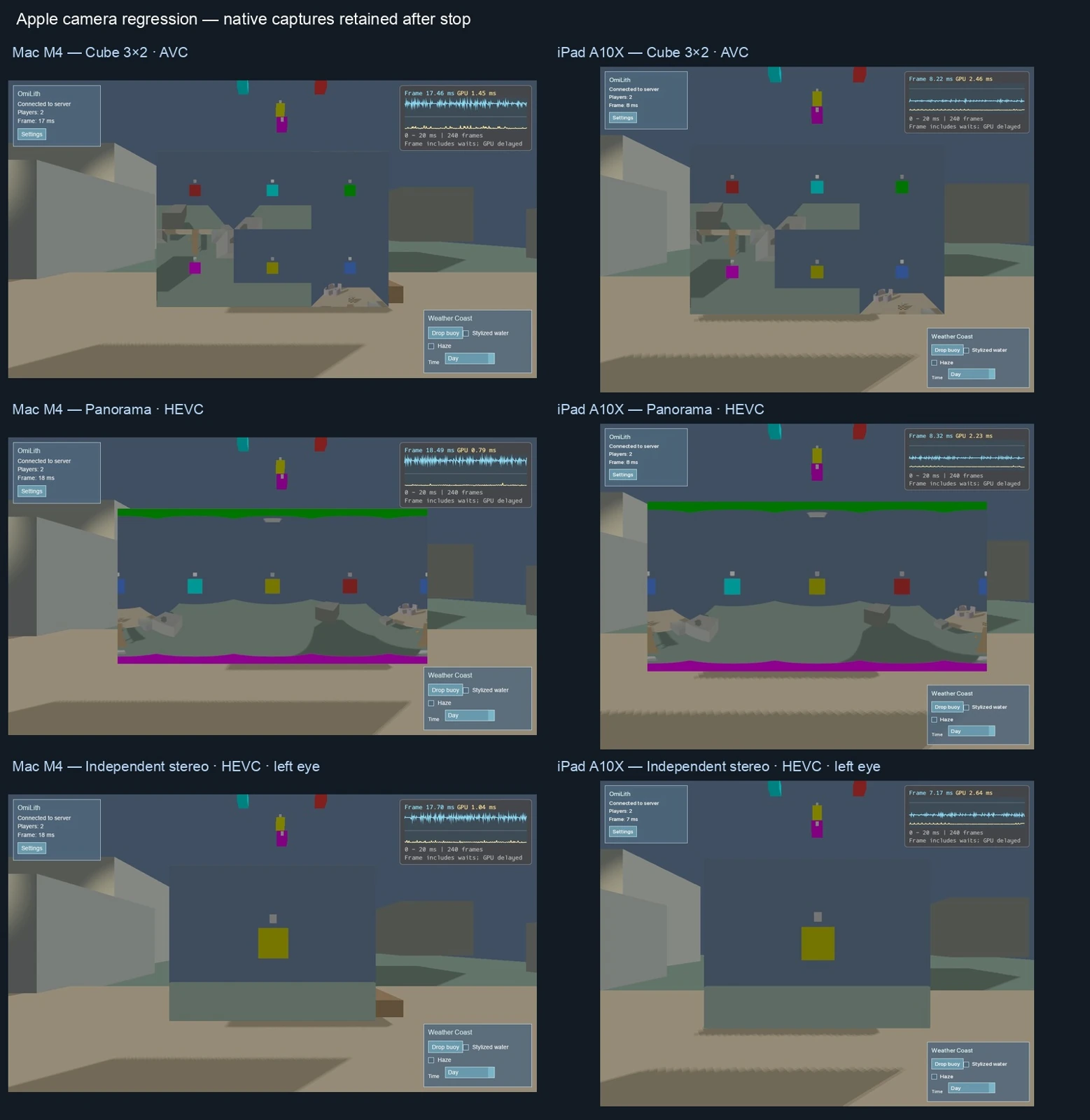
The reusable-game foundation reached its cumulative checkpoint as native media work began turning real game frames into independently decodable files. Recording was useful for the journal, but it also forced ownership and timing questions into the open: who retains a frame, which clock gives it a timestamp, and what happens when a session stops while another continues?
A file is evidence only after it can be read
The diary includes concurrent MP4 and Matroska sessions, native decoding checks, unsupported-codec behavior, and stop-edge investigations. Apple camera work exercised perspective, cube, panorama, and independent stereo outputs. Those are different source and lifetime cases, rather than interchangeable screenshots of a record button.
Windows native MP4 from the 16 October concurrent-recording checkpoint. The clip documents captured output, not ordinary game-performance cost.
The native-media deep dive follows the bounded-session design and the distinction between native and browser capability paths. It also retains the recorded acceptance limits rather than turning one successful codec test into universal support.
Loading and lighting have similar ownership questions
The lighting work separated static visibility and baked diffuse contribution from live direct lighting and moving-object shadows. Meanwhile, streamed-world development introduced coarse representations, retained fallbacks, and resource leases. A matched Mac route comparison supported keeping a simpler frustum path as a forest default instead of selecting a more elaborate visibility method by assumption.
At the end of this window, some final streamed-world platform checks were still pending. Later acceptance belongs to the following period. The useful thread through capture, baking, and streaming was the same: make resource ownership explicit, measure the selected path, and preserve enough context for a result to be understood later.
Have a thought or a question?
I'd love to hear it. ↗