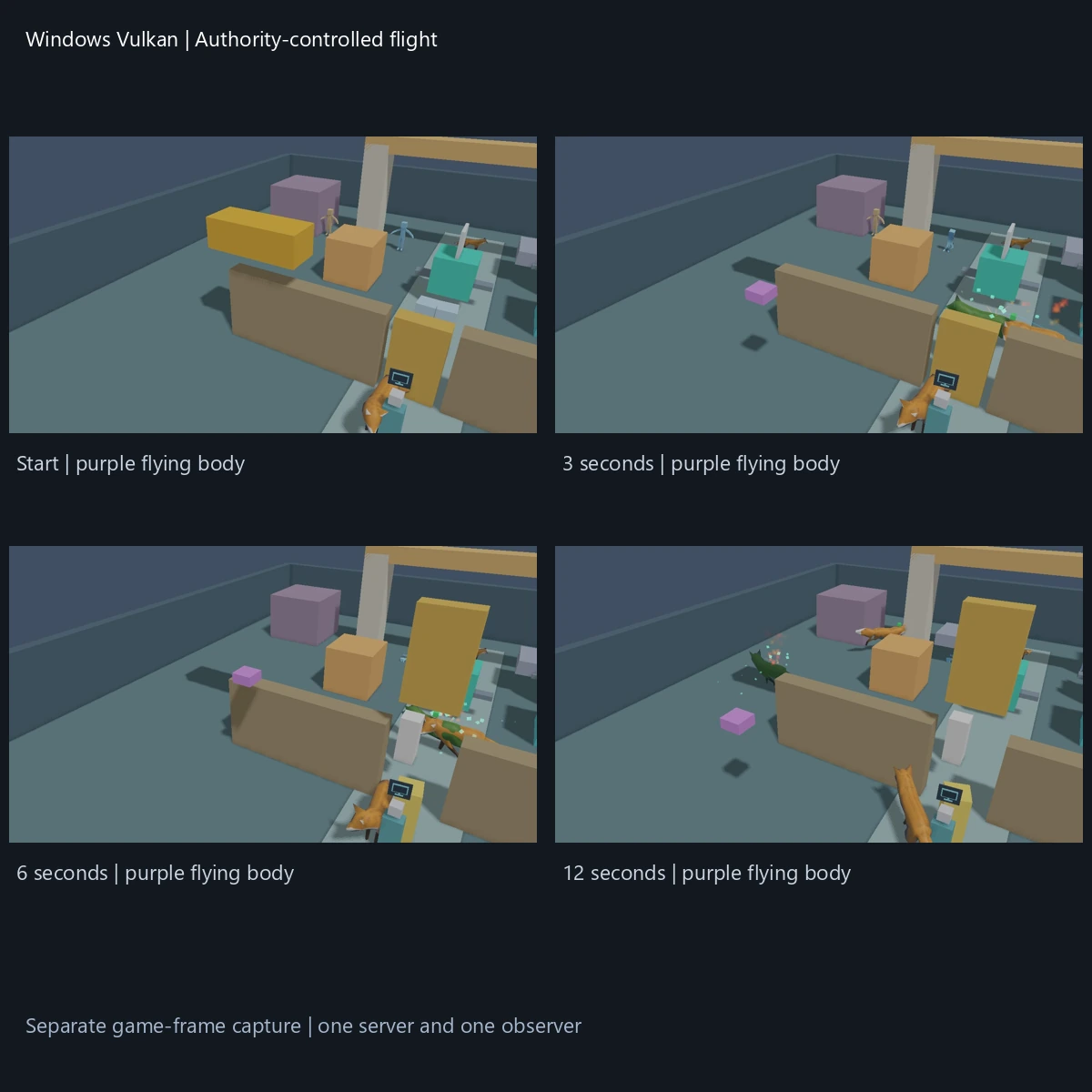
This window connected several reusable systems to visible game behavior: authority-driven AI, skeletal and procedural animation, programmable particles, streamed-world lifetimes, persistent sessions, and optional spatial voice. The important architectural theme was that visual richness should not change who owns gameplay.
Presentation can vary while authority stays shared
Device captures labelled full and portable effect tiers. The same programmable-particle foundation could choose a different visual workload while gameplay remained authoritative. The drone study similarly showed a server-owned route through real collision geometry rather than an animation pretending to be a networked simulation.
A reconnect fixture exposed another subtlety. Clients retained different actors through relevance hysteresis because the test ended in different interest circumstances. Moving the route endpoint into a shared cell preserved the exact state comparison instead of weakening it. That is a useful example of correcting the experiment while keeping the required invariant.
Voice needs lifecycle and policy, not just samples
The voice work kept channels, mutes, and personal-space rules ahead of reusable server mixing. Microphone backgrounding and explicit re-enabling were separate checks. A foreground return was not treated as permission to resume capture automatically.
The cumulative voice review was merged on 20 October with recorded checks across Windows, Mac, browser, phone, Quest, and physical iPad. Xbox microphone input and physical audio latency remained separate hardware qualifications. Those limits are part of the result.
Drune became a concrete consumer
The same period produced a PC checkpoint for multiplayer driving, drifting, jumps, recovery, shared markers, and layered audio. That supplied a more demanding consumer for the reusable engine than an isolated effect viewer. Terrain contact, distance, vehicle motion, and network state all meet in one camera.
The later multiplayer article explains how that experience led to a more explicit lag and replication audit. The engine-boundary note describes why the reusable machinery and a game’s particular rules should continue to evolve separately.
Have a thought or a question?
I'd love to hear it. ↗