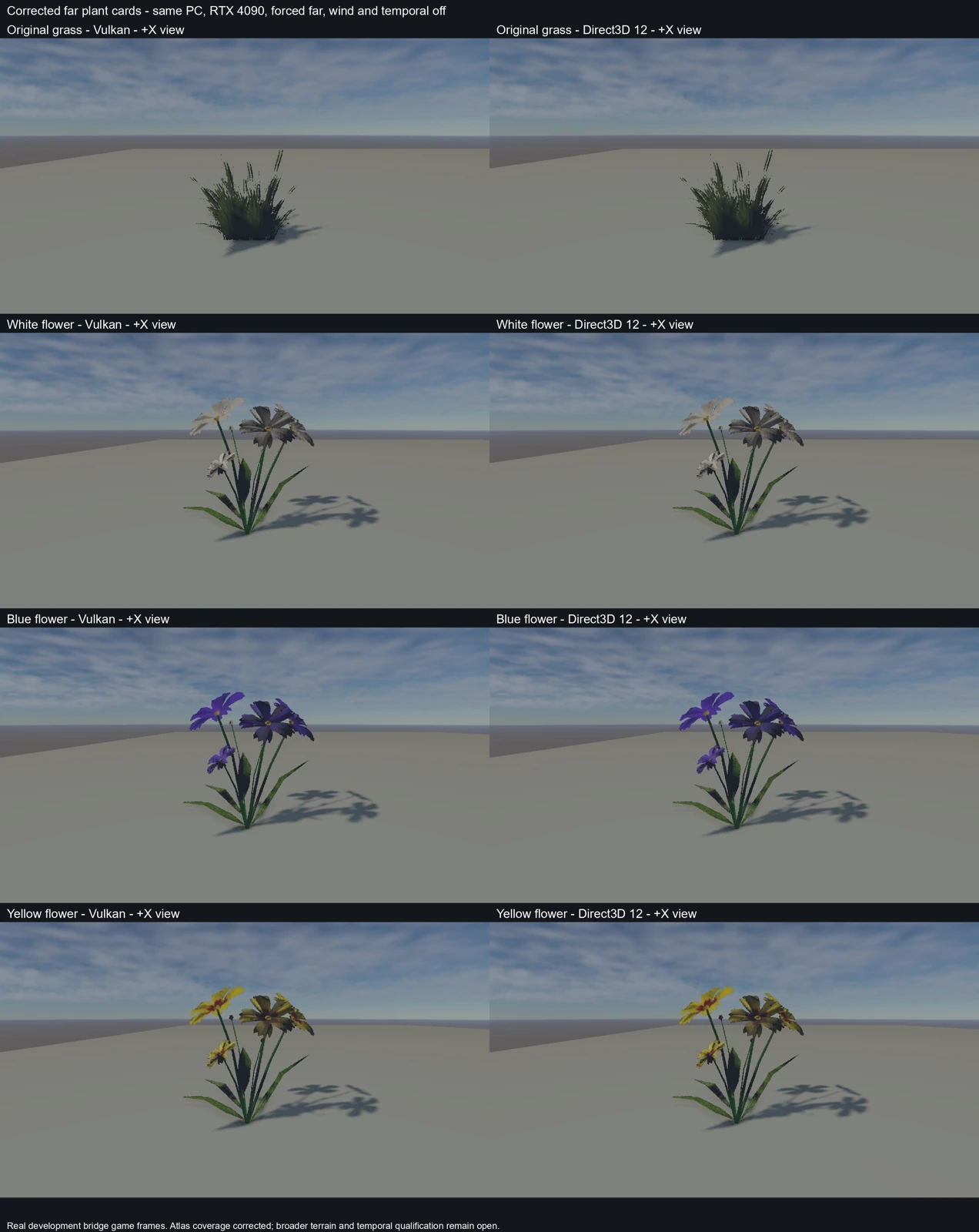
This was the busiest three-day group in the audited diary. Water, vegetation, and renderer optimization were producing visible results while a separate multiplayer audit exposed where freshness and resource cost needed more explicit treatment.
A material correction can matter more than density
The grass and flower studies corrected card behavior and tested the changing views through an orbit. Terrain fitting then addressed cosmetic rocks whose source heights disagreed with coarser rendered terrain. The engine supplied a bounded fitting helper while the game kept its placement and art choices.
The vegetation review was completed and merged on 26 October with documented Windows, Mac, and physical iPad validation. Other platform coverage remained scoped in the review. The renderer-optimization milestone had reached its own closed checkpoint on 25 October; these were connected bodies of work, but they retained separate evidence.
Water grew from optical foundation to a fuller surface
24 October Windows choppy-wave study. The source recorded 148 of 150 requested capture frames at a 15 fps target. Reflections, foam, and underwater optics were still in progress. The poster comes from that recording.
The physics and graphics responsibilities remained separate. The authority needed bounded height, normal, and velocity queries; the GPU could provide a richer visual reconstruction without changing the forces applied to bodies. Underwater sound, foam, and particle studies added their own lifetime and quality checks.
A network audit should preserve its unanswered questions
The multiplayer review found a fixed-intake scaling risk and split single-server improvements from later distributed-world work. Subsequent source changes added bounded per-player inboxes, more direct relevance queries, and snapshot-codec work. Pause/resume and save/isolation checks supplied concrete evidence, while capacity benchmarking and final qualification remained deferred.
The related deep dives cover physical versus visual water, coverage-preserving vegetation, and freshness in replicated state. None uses an attractive capture as a replacement for a capacity or frame-time result.
Have a thought or a question?
I'd love to hear it. ↗