The realistic-water milestone reached its accepted checkpoint on 27 October. The later Mac showcase documented clear shallows, underwater views, rough water, and a night preset while retaining visible limitations. That was followed by a different kind of rendering work: make the content inspectable and make startup usable on constrained routes.
Inspect what the game actually loaded
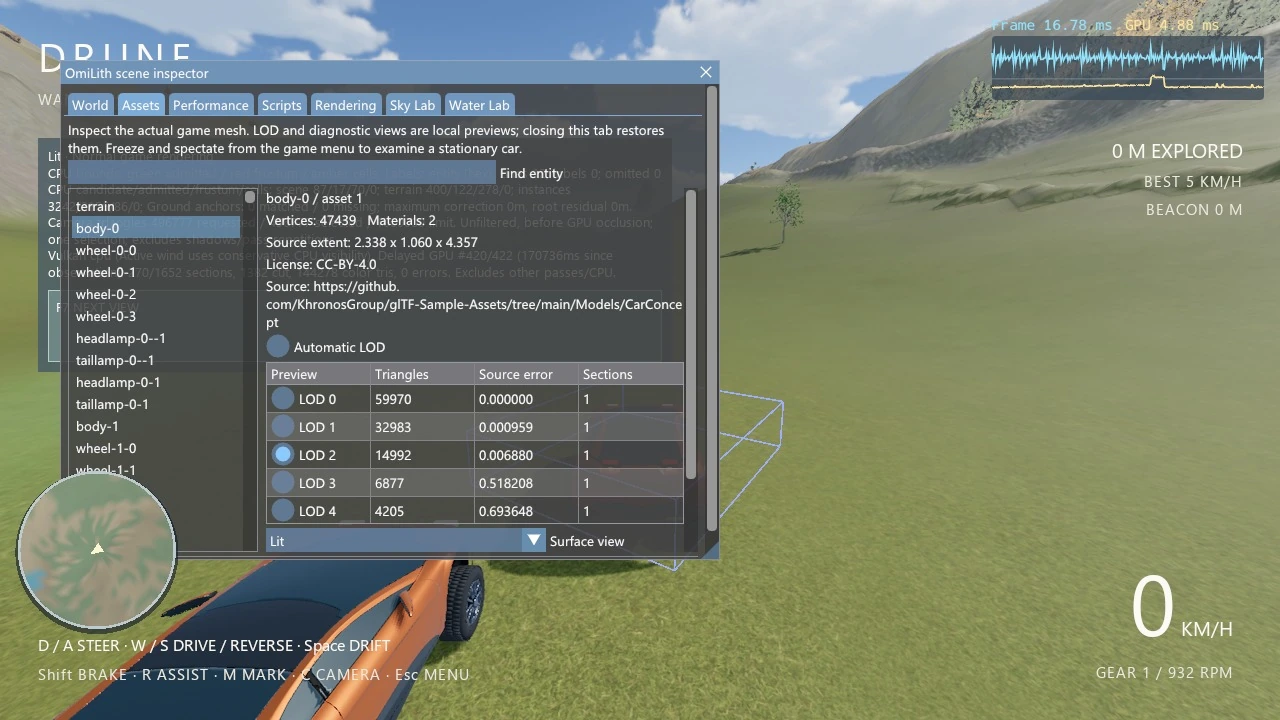
Drune’s asset view exposed the cooked car, its stored detail levels, errors, metadata, source, and licence. Leaving the inspector restored ordinary driving settings. Terrain work kept source spacing, the shared physical surface, and the rendered representation distinguishable rather than collapsing them into one resolution label.
The Drune presentation review and a following startup/bloom checkpoint closed on 29 October. Device-memory, Quest, and particular Xbox water qualifications remained separately tracked. Those explicit gaps are more useful than a blanket claim that all devices have identical cost and behavior.
A minimal menu is an architectural boundary
Glasswake’s newer delivery work aimed to begin with minimal menu assets, request a playable scene after Play, and refine nearby content within measured budgets. The audited issue was still in progress. It builds on the accepted residency foundation, but it has to prove a complete consumer path rather than inherit acceptance from the older engine milestone.
The asset-residency article follows those ownership and publication boundaries. The platform note explains why cold shader preparation and the first usable frame deserve their own evidence.
Keep the next plan separate from today’s result
A static architecture review recorded further shared-service extraction and Lua-first game-boundary recommendations. It found that Glasswake already used Lua for gameplay and that Drune offered more opportunities for extraction. It made no source edits or device-test claims.
PanoPainter’s last post in this snapshot recorded successful Windows startup/shutdown and a warning-free Mac build while final application and release review remained open. Its older tracker history supplies the panoramic-canvas and document-system article. This keeps the creative app in the development story without pretending that the relatively short OmiComm archive contains its entire history.
Have a thought or a question?
I'd love to hear it. ↗